What the numbers mean on a boat
| Question | Answer | How it is worked out |
|---|---|---|
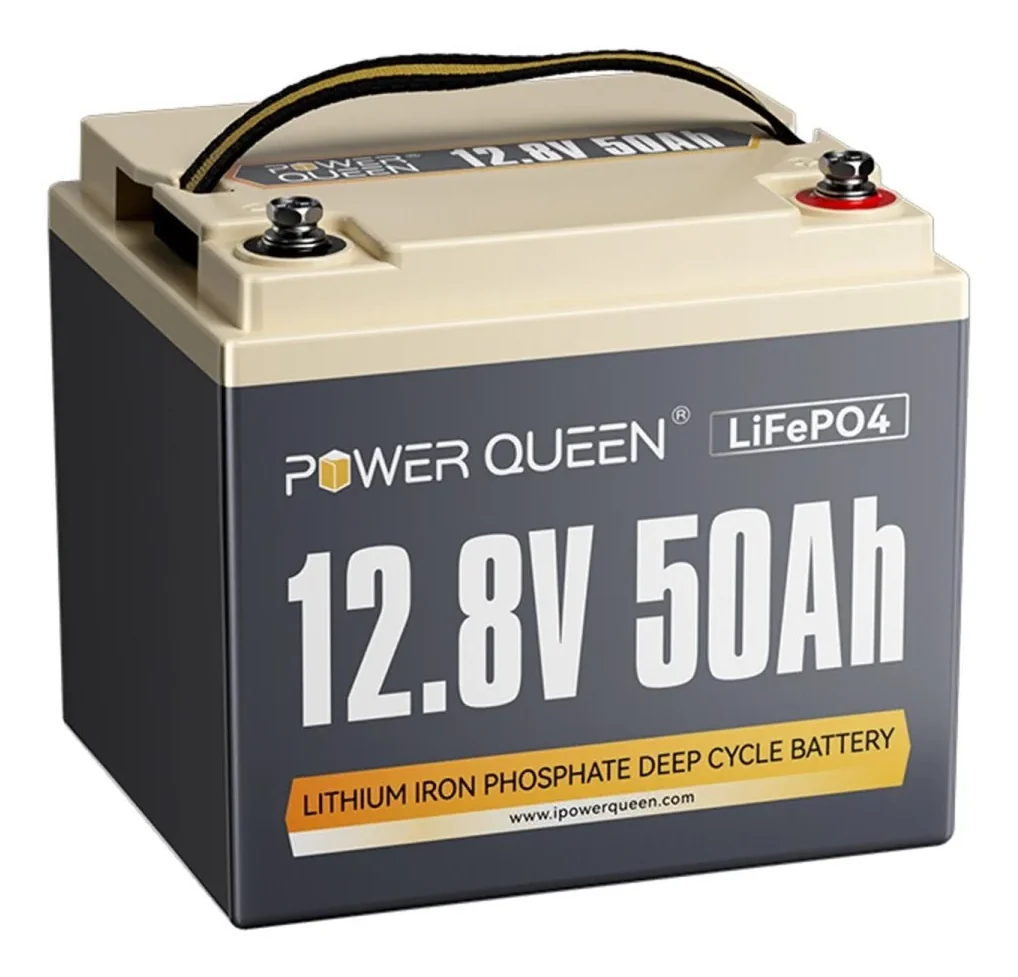
| Stored energy | 640 Wh | Manufacturer figure |
| Largest continuous inverter load on this battery alone | ≈ 580 W | 50 A × 12.8 V × 90% inverter efficiency |
| Runtime at a steady 10 A — electronics (sonar, plotter, lights) | ≈ 5.0 h | 50 Ah ÷ 10 A; illustrative load |
| Runtime at a steady 30 A — trolling motor, moderate speed | ≈ 1.7 h | 50 Ah ÷ 30 A; illustrative load |
Trolling-motor setups
| Motor voltage | Batteries needed |
|---|---|
| 12 V motor | 1 |
| 24 V motor | 2 in series |
| 36 V motor | 3 in series |
Charging time from 20% to full
| Charger | Approximate time |
|---|---|
| 10 A charger | ≈ 4.0 h |
| 20 A charger | ≈ 2.0 h |
| 50 A (the battery's maximum charge current) | ≈ 0.8 h |
Calculated as 80% of 50 Ah divided by charger current; real charging takes somewhat longer as current tapers near full.
Its 50 A continuous rating is below the 58 A maximum draw of a high-thrust motor such as the Minn Kota Ultrex QUEST 90/115 — check your motor’s maximum amp draw before choosing it.
Paired with a 3,000 VA, 12 V inverter/charger such as the Victron MultiPlus-II 12/3000 (≈ 215 A at full output), you would need at least 5 of these in parallel to carry full continuous load, and 3 to accept its full 120 A charge current (or lower the charger setting).
Will it work on your boat?
Worked out from the manufacturer's published figures. Confirm against your boat before ordering.
- ✓ChargerA LiFePO4 charging profile, about 14.4 V, and no more than 50 A per battery.
- ✓Continuous loadUp to 50 A per battery; add batteries in parallel for more.
- ?SpaceMeasure the tray or compartment: L7.79*W6.53*H6.69 inch.
- ?Cold weatherNo self-heating listed; LiFePO4 generally must not be charged below freezing — check the manufacturer's low-temperature limits.
Specifications
Each figure is labelled with where it comes from. Numbered references link to the source list below.
Manufacturer specifications
| Cell Type | LiFePO4[S1] | Manufacturer spec |
|---|---|---|
| Warranty | 5 Years[S1] | Manufacturer spec |
| Cycle Life | 4000 cycles at 100% DOD, 6000 cycles at 80% DOD, 15,000 cycles at 60% DOD[S1] | Manufacturer spec |
| Nominal Voltage | 12.8V[S1] | Manufacturer spec |
| Rated Capacity | 50Ah[S1] | Manufacturer spec |
| Energy | 640Wh[S1] | Manufacturer spec |
| Max. Expansion (Parallel & Series) | 4P4S[S1] | Manufacturer spec |
| Certifications | FCC,CE,RoHS,UN38.3[S1] | Manufacturer spec |
| BMS | BMS: 50A Max. Continuous Output Power: 640W Max. Continuous Charge Current: 50A Max. Continuous Discharge Current: 50A Max. Discharge Current 5 Seconds: 100A[S1] | Manufacturer spec |
| Max. Continuous Charge Current | 50A[S1] | Manufacturer spec |
| Charge Voltage | 14.4V ± 0.2V[S1] | Manufacturer spec |
| Charge Temperature | 0℃ to 50℃ / 32℉ to 122℉[S1] | Manufacturer spec |
| Discharge Temperature | -20℃ to 60℃ / -4℉ to 140℉[S1] | Manufacturer spec |
| Low-Temperature Protection | N/A[S1] | Manufacturer spec |
| Weight Approx. | 11.57 lbs[S1] | Manufacturer spec |
| Size | L7.79*W6.53*H6.69 inch[S1] | Manufacturer spec |
| Protection Class | IP65[S1] | Manufacturer spec |
Derived and commercial
| Observed price | $161.99 at Power Queen (24 Sep 2026)[S1] | Retailer listing |
|---|
Limitations to weigh
- No self-heating listed — charging below freezing is restricted.
- 50 A continuous limit: not for high-draw trolling motors or large inverters on a single battery.
- Deep-cycle use; not rated for engine starting.
Alternatives and companions
Where to buy
Our links go to the product page for this exact model, at the retailer and at the manufacturer. Prices and stock change; check before you order.
Links go to the exact product page for this model. We may earn a commission; it never affects our coverage. Disclosure
Sources and verification
- Power Queen — Power Queen 12V 50Ah Deep Cycle Lithium Battery — product page and specifications Retrieved 24 Sep 2026
Nautworthy has not tested this product hands-on; this reference is built from the sources above. Last verified 24 Sep 2026. How we work