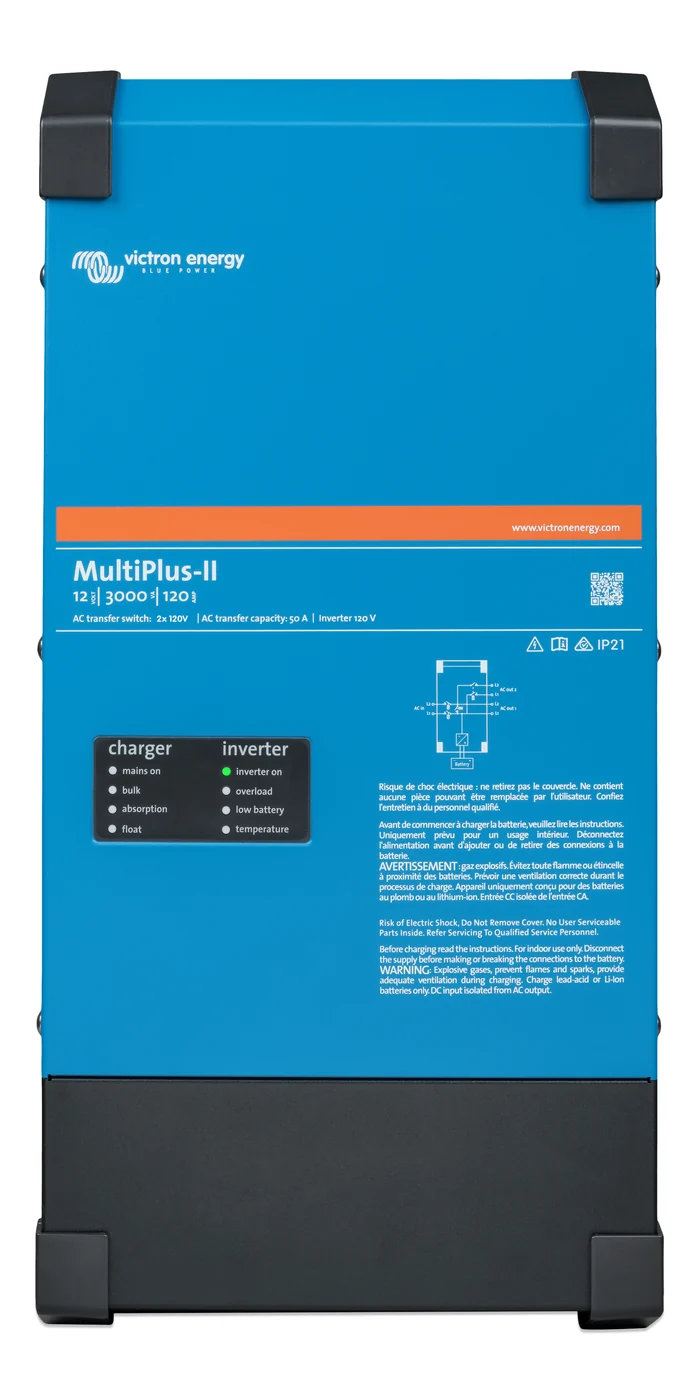
How the 2x120V version handles shore power
The AC input accepts a split-phase 120/240 V source (such as a 50 A shore cord) or a single-phase 120 V source. With AC present, the unit passes it through to its outputs, so both legs mirror the input. The inverter/charger itself connects to neutral and the preferred input line (L1), so power for battery charging is drawn from L1.
When shore or generator power disappears, the unit inverts from the battery and ties both output lines (L1 and L2) together to supply 120 V to loads on either line. Victron notes that 240 V loads are therefore only supplied when a split-phase source is connected — a deliberate design that stops heavy loads from draining the bank.
| Condition | L1 output | L2 output | 240 V loads |
|---|---|---|---|
| Split-phase shore/generator | Pass-through | Pass-through | Supplied |
| No AC input (inverting) | 120 V from battery | 120 V from battery (tied to L1) | Not supplied |
Transfer to the battery takes under 18 ms on L1 — fast enough, Victron says, for computers and electronics to keep running — and about 40 ms on L2. A second, auxiliary output is live only when AC input is present; wire loads there that should never run from the battery.
PowerControl and PowerAssist
Set a maximum input current and the unit manages it. PowerControl reduces battery charging so that charging plus your AC loads never exceed a weak shore pedestal or small generator. PowerAssist goes further: when loads briefly exceed the input limit, the MultiPlus-II supplements from the battery, then recharges when demand falls. PowerAssist works on the L1 input.
What it asks of your battery bank
This is where 12 V installs go wrong. At 2,400 W continuous output and Victron's 93% maximum efficiency, DC input current is roughly 2,400 ÷ (12 × 0.93) ≈ 215 A — more at lower battery voltage and lower efficiency. The battery bank, its fusing and its cables must be sized for that current, not for the average load.
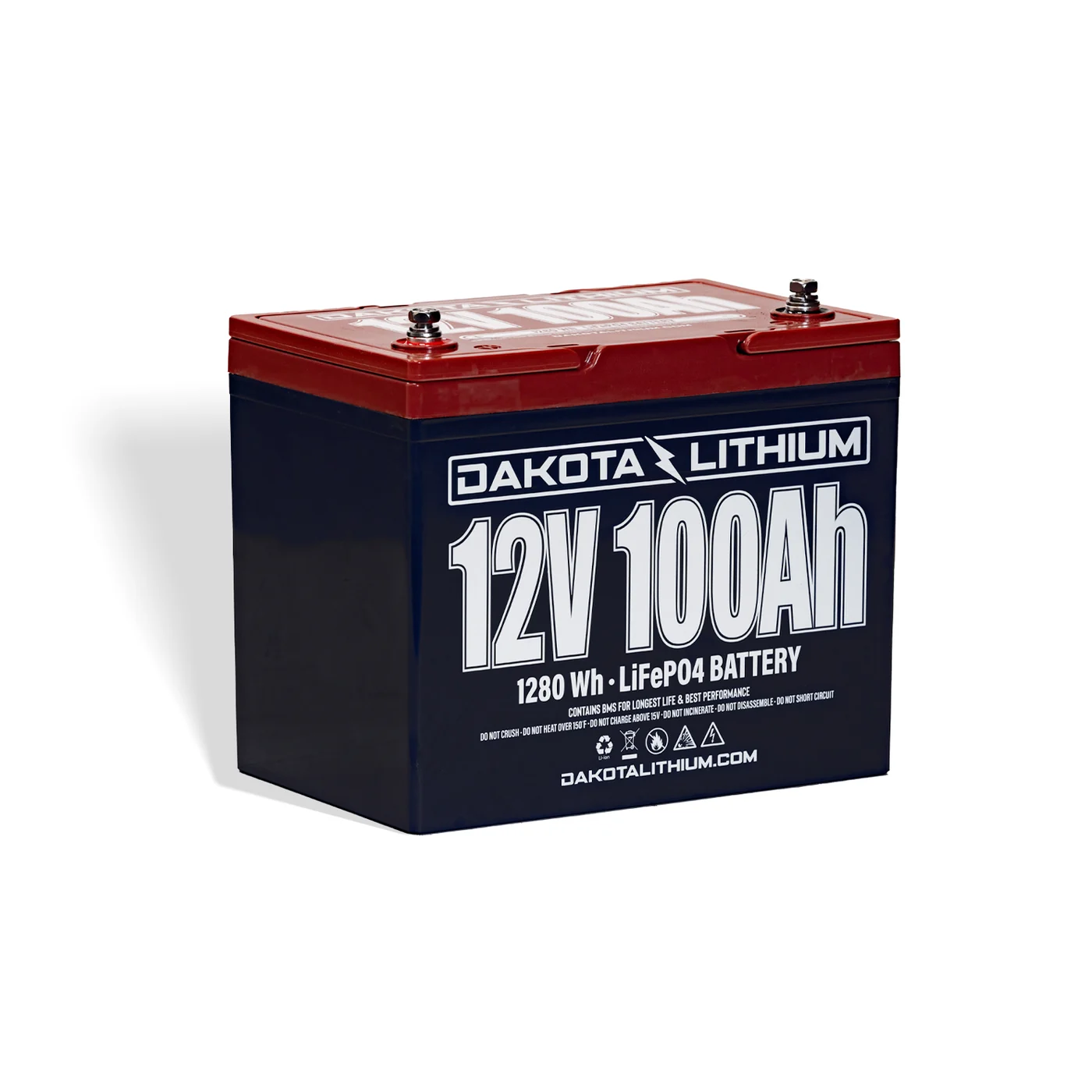
Using Dakota Lithium's 12 V 100 Ah heated battery as an example: it is rated for 100 A continuous discharge and 50 A maximum charge. To support full continuous inverter output you would need at least three in parallel (300 A continuous), and to accept the full 120 A charge current, at least three (150 A combined). The charger's absorption voltage of 14.4 V matches Dakota's recommended charge voltage.
| Check | MultiPlus-II figure | Dakota 100 Ah (each) | Minimum batteries |
|---|---|---|---|
| Continuous discharge | ≈ 215 A at 2,400 W | 100 A | 3 in parallel |
| Charge current | 120 A max | 50 A max | 3 in parallel |
| Absorption voltage | 14.4 V | 14.4 V recommended | Compatible |
Monitoring, expansion and installation
The unit is configured with VictronConnect or VEConfigure (an MK3-USB interface is needed for full configuration). It can be monitored from a Cerbo GX or Ekrano GX, which also gives free remote access through Victron's VRM portal, or from the VE.Bus Smart dongle over Bluetooth. Two general-purpose communication ports let it talk to a lithium battery management system.
Up to six units can run in parallel for more power. Physically, it is a 48 lb (22 kg) steel enclosure measuring 23 × 11 × 6 in, with fan-assisted cooling and an IP22 rating — mount it in a dry, ventilated compartment, never in the bilge.
Will it work on your boat?
Check these against your boat's electrical plan before ordering.
- ✓Battery voltage12 V bank (DC input range 9.5–17 V). 24 V systems need the 24/3000/70-50 variant.
- ✓Battery bank capacityMust supply roughly 215 A continuous at full output and accept up to 120 A of charge current (configurable).
- ?Shore powerDesigned for split-phase 120/240 V input up to 50 A per leg; also runs from single-phase 120 V.
- ?240 V appliancesRun only when a split-phase shore or generator source is connected.
- ✓LocationIP22 enclosure: dry, ventilated space; 23 × 11 × 6 in and 48 lb.
- iMonitoringOptional Cerbo GX / Ekrano GX, Digital Multi Control or VE.Bus Smart dongle.
Specifications
Each figure is labelled with where it comes from. Numbered references link to the source list below.
Inverter
| DC input voltage range | 9.5–17 V[S1] | Manufacturer document |
|---|---|---|
| Output | 120 VAC ± 2%, 60 Hz ± 0.1%[S1] | Manufacturer document |
| Continuous output at 25 °C | 3,000 VA / 2,400 W[S1] | Manufacturer document |
| Continuous output at 40 °C / 65 °C | 2,200 W / 1,700 W[S1] | Manufacturer document |
| Peak power | 5,500 W[S1] | Manufacturer document |
| Maximum efficiency | 93%[S1] | Manufacturer document |
| Zero-load power (normal / AES / Search) | 15 W / 10 W / 4 W[S1] | Manufacturer document |
Charger and transfer
| AC input | Split phase 180–280 VAC or single phase 90–140 VAC, 55–65 Hz[S1] | Manufacturer document |
|---|---|---|
| Transfer switch / max AC input | 50 A / 50 A per leg[S1] | Manufacturer document |
| Charge voltage (absorption / float / storage) | 14.4 V / 13.8 V / 13.2 V[S1] | Manufacturer document |
| Maximum charge current | 120 A (up to 25 °C ambient)[S1] | Manufacturer document |
| Transfer time | < 18 ms on L1; ≈ 40 ms on L2[S1] | Manufacturer document |
| PowerControl / PowerAssist | Yes (on L1 input)[S1] | Manufacturer document |
| Auxiliary output | 50 A per leg; live only with AC input (early batch, serials HQ2107: 35 A)[S1] | Manufacturer document |
General and enclosure
| Communication | VE.Bus; 2 general-purpose ports; remote on/off; programmable relay[S1] | Manufacturer document |
|---|---|---|
| Battery temperature sensor | Yes[S1] | Manufacturer document |
| Operating temperature | −40 to 150 °F (−40 to 65 °C), fan-assisted[S1] | Manufacturer document |
| Protection category | IP22[S1] | Manufacturer document |
| Battery connection | 2 × 2 M8 bolts[S1] | Manufacturer document |
| AC connection | Screw terminals, 21 mm² (4 AWG)[S1] | Manufacturer document |
| Weight / dimensions (h × w × d) | 48 lb (22 kg) / 23 × 11 × 6 in (578 × 275 × 148 mm)[S1] | Manufacturer document |
| Safety standards | EN-IEC 60335-1, EN-IEC 60335-2-29, UL 458[S1] | Manufacturer document |
Derived figures
| DC current at 2,400 W | ≈ 215 A (2,400 ÷ (12 × 0.93)) | Nautworthy calculation |
|---|---|---|
| Observed price | Not verified — Victron sells through dealers | Not verified |
Limitations to weigh
- Inverter output is 120 V only; 240 V loads need split-phase shore or generator power.
- IP22 enclosure: not for wet or bilge locations.
- Full output needs a large 12 V bank and heavy DC cabling (≈ 215 A).
- Victron's product page covers the whole MultiPlus-II 2x120V series; confirm you are buying the 12/3000/120-50 variant.
Alternatives and companions
Where to buy
Our links go to the product page for this exact model, at the retailer and at the manufacturer. Prices and stock change; check before you order.
Links go to the exact product page for this model. We may earn a commission; it never affects our coverage. Disclosure
Sources and verification
- Victron Energy — Datasheet — MultiPlus-II 2x120V Inverter/Charger Retrieved 23 Sep 2026
- Victron Energy — MultiPlus-II 2x 120V — product page Retrieved 23 Sep 2026
- Dakota Lithium — 12V 100Ah Deep Cycle Heated LiFePO4 Battery — technical specifications Retrieved 23 Sep 2026
Nautworthy has not tested this product hands-on; this reference is built from the sources above. Last verified 23 Sep 2026. How we work