
Size the inverter from the AC loads you will run at the same time, plus headroom, at the temperature where it will live. Size the battery bank from daily energy use. Then run the two checks most upgrades miss: the bank's continuous-discharge rating must cover the inverter's DC current, and its maximum charge rate must cover the charger's output.
- Inverter continuous rating ≥ simultaneous AC load × 1.25
- Bank Ah = daily Wh × days ÷ (nominal V × usable fraction)
- DC current = AC watts ÷ (battery V × efficiency)
- Charger current ≤ sum of each battery's maximum charge current
1. Find your simultaneous AC load
List every 120 V appliance, then decide which could realistically run together — the coffee maker and the microwave at breakfast, say. Add their running watts. That sum, not the total of everything aboard, is what the inverter must carry continuously. Add about 25% headroom so the inverter is not running at its limit.
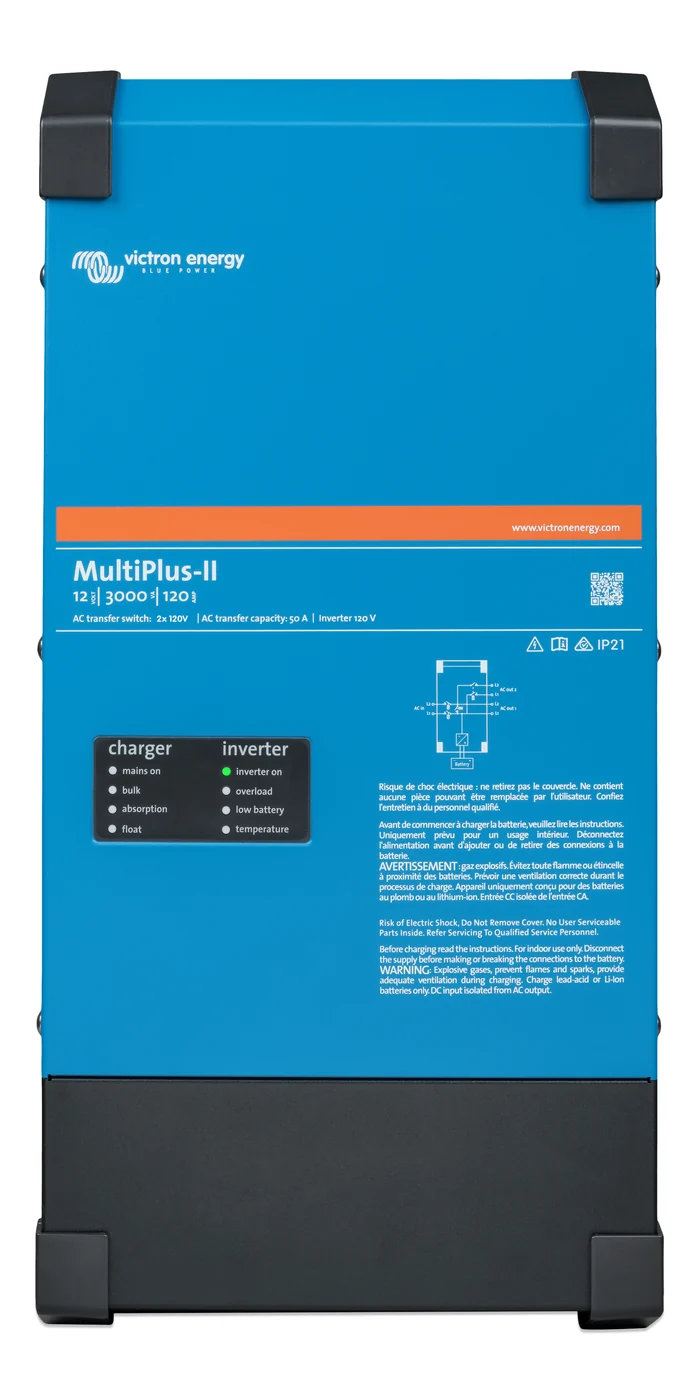
Motors and compressors also draw a brief start-up surge well above their running watts. Check the appliance's documentation and compare it with the inverter's peak rating — 5,500 W for the Victron MultiPlus-II 12/3000.
2. Derate for heat
Continuous ratings are quoted at 25 °C (77 °F). Engine rooms and lockers run hotter, and output falls with temperature. Victron's datasheet shows how much for the MultiPlus-II 12/3000:
| Ambient temperature | Continuous output |
|---|---|
| 25 °C / 77 °F | 2,400 W |
| 40 °C / 104 °F | 2,200 W |
| 65 °C / 150 °F | 1,700 W |
If the inverter will sit in a warm compartment, plan against the 40 °C figure or improve ventilation.
3. Add up daily energy — including idle draw
For each load, multiply watts by hours of use per day. Divide AC loads by the inverter's efficiency to get the DC energy they take from the battery (Victron quotes 93% maximum; 90% is a sensible planning figure). Add DC loads directly.
Then add the inverter itself. The MultiPlus-II 12/3000 uses 15 W with no load — 360 Wh a day if it is left on, about 28 Ah from a 12.8 V bank. Victron's AES mode cuts that to 10 W and Search mode to 4 W (96 Wh a day).
4. Size the bank
Bank capacity in amp-hours = daily Wh × days of autonomy ÷ (nominal voltage × usable fraction). For lithium iron phosphate, a usable fraction of 0.8 is a conservative planning assumption; for lead-acid, 0.5 is common to protect cycle life. These are planning conventions, not manufacturer ratings — check your battery maker's guidance.
5. Check the DC current
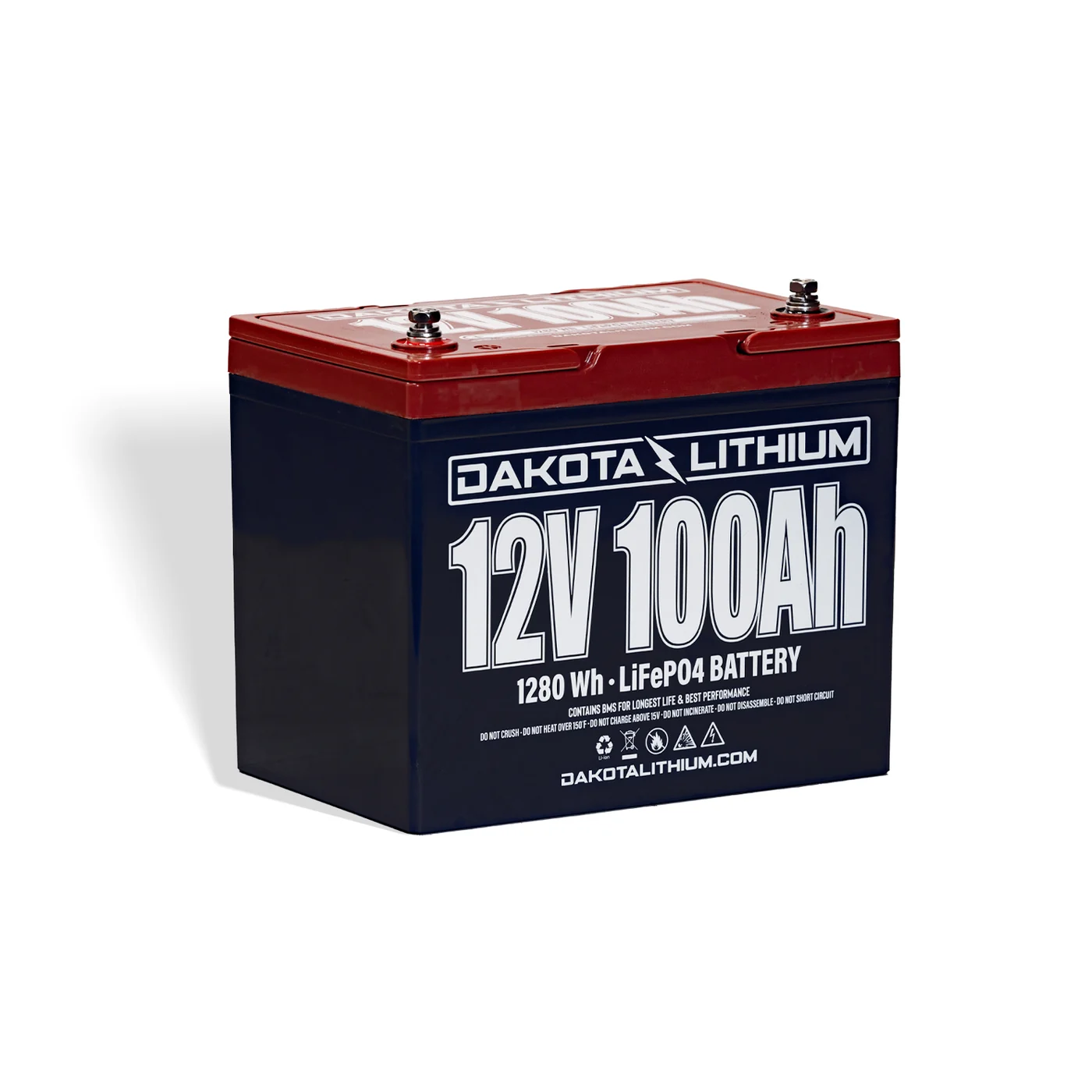
DC current = AC watts ÷ (battery voltage × efficiency). At 2,400 W, 12 V and 93%, that is about 215 A. Every battery has a continuous-discharge limit — 100 A for the Dakota Lithium 12 V 100 Ah — so the bank needs enough batteries in parallel to share the current. Cables and the main fuse must be rated for it too; have a qualified marine electrician design them to ABYC E-11.
6. Match the charger to the bank
An inverter/charger's charge current is a maximum you can lower. The MultiPlus-II 12/3000 charges at up to 120 A; the Dakota battery accepts up to 50 A. Three in parallel accept 150 A, so the full 120 A is safe; with two, set the charger to 100 A or less. Also match voltages: the MultiPlus-II absorbs at 14.4 V, the voltage Dakota recommends.
Worked example: a weekend cruiser
| Load | Watts | Hours/day | Wh/day (DC) |
|---|---|---|---|
| Coffee maker (AC) | 1,000 | 0.2 | 222 |
| Microwave (AC) | 1,200 | 0.25 | 333 |
| TV (AC) | 80 | 3 | 267 |
| Laptop charging (AC) | 60 | 4 | 267 |
| Refrigerator (DC, average) | 45 | 24 | 1,080 |
| Helm electronics (DC) | 60 | 6 | 360 |
| Lighting (DC) | 30 | 5 | 150 |
| Inverter idle, Search mode | 4 | 24 | 96 |
| Total | 2,775 |
AC figures are divided by 0.9 inverter efficiency. For one day without charging: 2,775 ÷ (12.8 × 0.8) ≈ 271 Ah — three 100 Ah batteries. Three batteries also clear the DC-current check (300 A against about 215 A) and the charge-current check (150 A against 120 A).
The inverter check is where this plan needs a decision. Coffee maker plus microwave is 2,200 W; with 25% headroom that is 2,750 W — above the MultiPlus-II 12/3000's 2,400 W continuous rating. Either run them one at a time, or look at the 12/4k/160-50 variant, which Victron rates at 3.4 kW continuous at 25 °C with a 160 A charger (and which then needs a bank that can accept 160 A).
Products referenced in this guide
Sources
- Victron Energy — Datasheet — MultiPlus-II 2x120V Inverter/Charger Retrieved 23 Sep 2026
- Dakota Lithium — 12V 100Ah Deep Cycle Heated LiFePO4 Battery — technical specifications Retrieved 23 Sep 2026