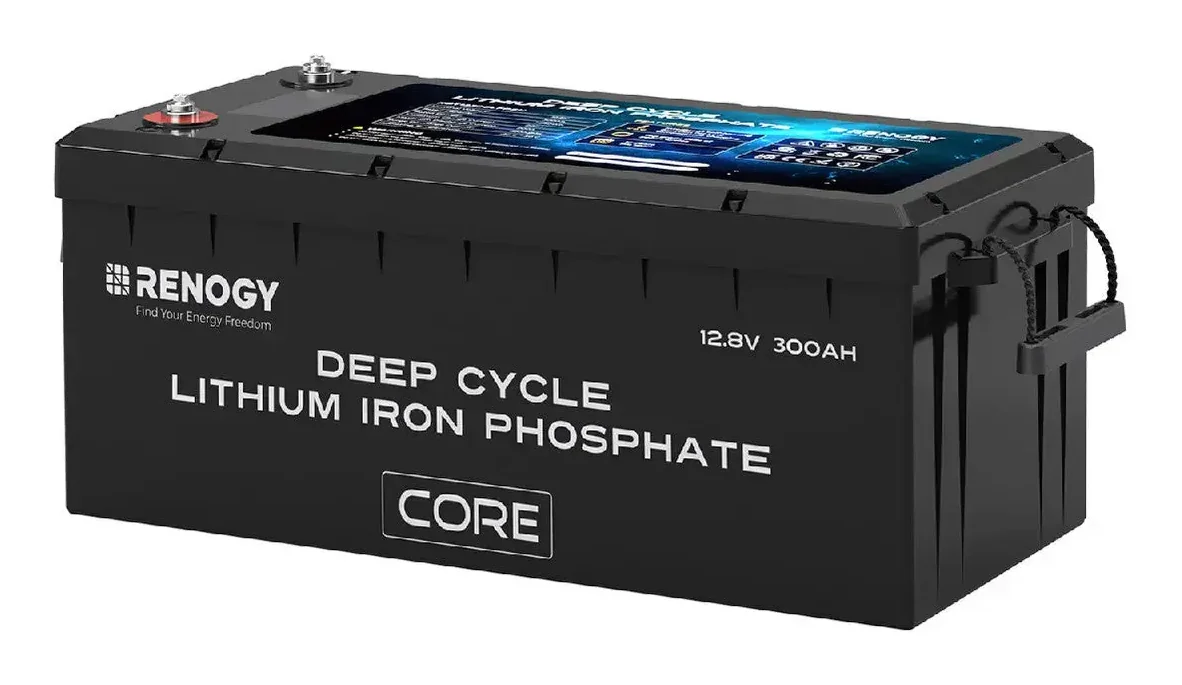
What the numbers mean on a boat
| Question | Answer | How it is worked out |
|---|---|---|
| Stored energy | 3,840 Wh | Calculated: 12.8 V × 300 Ah |
| Largest continuous inverter load on this battery alone | ≈ 2,300 W | 200 A × 12.8 V × 90% inverter efficiency |
| Runtime at a steady 10 A — electronics (sonar, plotter, lights) | ≈ 30 h | 300 Ah ÷ 10 A; illustrative load |
| Runtime at a steady 30 A — trolling motor, moderate speed | ≈ 10 h | 300 Ah ÷ 30 A; illustrative load |
Trolling-motor setups
| Motor voltage | Batteries needed |
|---|---|
| 12 V motor | 1 |
| 24 V motor | 2 in series |
| 36 V motor | 3 in series |
Charging time from 20% to full
| Charger | Approximate time |
|---|---|
| 10 A charger | ≈ 24 h |
| 20 A charger | ≈ 12 h |
| 200 A (the battery's maximum charge current) | ≈ 1.2 h |
Calculated as 80% of 300 Ah divided by charger current; real charging takes somewhat longer as current tapers near full.
Its 200 A continuous rating covers the 58 A maximum draw of a high-thrust motor such as the Minn Kota Ultrex QUEST 90/115.
Paired with a 3,000 VA, 12 V inverter/charger such as the Victron MultiPlus-II 12/3000 (≈ 215 A at full output), you would need at least 2 of these in parallel to carry full continuous load, and 1 to accept its full 120 A charge current (or lower the charger setting).
Will it work on your boat?
Worked out from the manufacturer's published figures. Confirm against your boat before ordering.
- ✓ChargerA LiFePO4 charging profile, about 14.4 V, and no more than 200 A per battery.
- ✓Continuous loadUp to 200 A per battery; add batteries in parallel for more.
- iCold weatherInternal heating is listed for charging in the cold.
Specifications
Each figure is labelled with where it comes from. Numbered references link to the source list below.
Manufacturer specifications
| Battery Type | Lithium Iron Phosphate[S1] | Manufacturer spec |
|---|---|---|
| Voltage | 12V[S1] | Manufacturer spec |
| Rated Capacity | 300Ah (0.5C, 25℃)[S1] | Manufacturer spec |
| Charge Voltage | 14.4V[S1] | Manufacturer spec |
| Maximum Charge Current | 200A[S1] | Manufacturer spec |
| Maximum Discharge Current | 200A[S1] | Manufacturer spec |
| Cycle Life (0.5C/1C, 25℃) | 5000 Cycles (80% DOD)[S1] | Manufacturer spec |
| Charge Temperature Range | '-4°F~131°F (-20°C~55°C)[S1] | Manufacturer spec |
| Discharge Temperature Range | '-4°F~140°F (-20°C~60°C)[S1] | Manufacturer spec |
Derived and commercial
| Stored energy | ≈ 3,840 Wh (nominal voltage × capacity) | Nautworthy calculation |
|---|---|---|
| Observed price | $1,088.99 at Renogy (23 Sep 2026)[S1] | Retailer listing |
Limitations to weigh
- Deep-cycle use; not rated for engine starting.
- No ingress-protection (IP) rating published — keep it in a dry location.
Alternatives and companions
Where to buy
Our links go to the product page for this exact model. Prices and stock change; check before you order.
Links go to the exact product page for this model. We may earn a commission; it never affects our coverage. Disclosure
Sources and verification
- Renogy — 12V 300Ah Deep Cycle Lithium Iron Phosphate Battery w/Self-Heating | Core Series — product page and specifications Retrieved 23 Sep 2026
Nautworthy has not tested this product hands-on; this reference is built from the sources above. Last verified 23 Sep 2026. How we work